
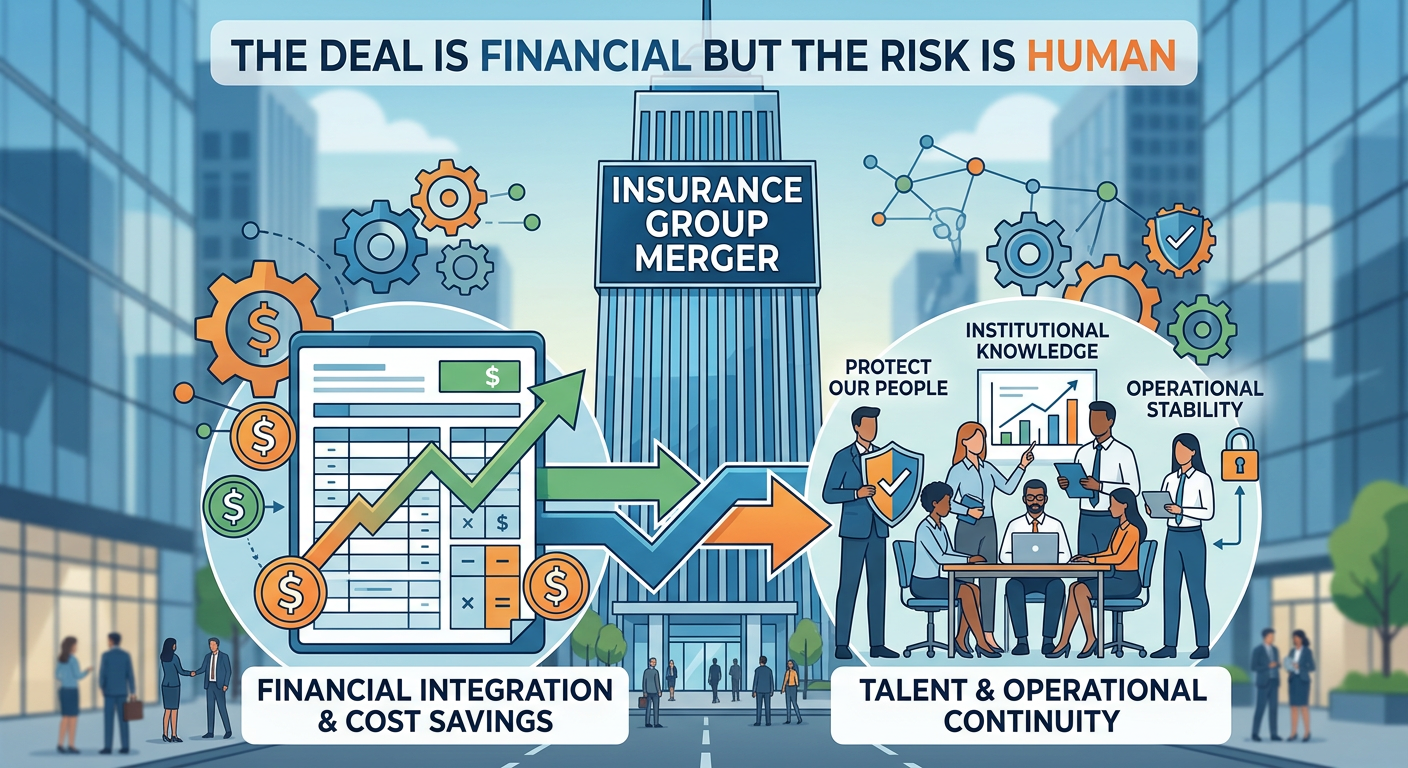
Insurance mergers may promise scale and efficiency, but the combined organization succeeds only if it protects its people, preserves institutional knowledge and maintains operational continuity.
Insurance mergers and acquisitions are usually announced in the language of strategy: greater scale, expanded capabilities, stronger market reach and increased efficiency.
Employees hear something else.
Will I still have a job? Who will I report to? Will my responsibilities, benefits or workplace arrangements change? Does the experience I have spent years building still matter Those questions are not distractions from the transaction. They are central to whether it succeeds. In insurance, the people carrying underwriting judgment, claims experience, regulatory knowledge and client history often determine whether the promised value of a deal survives the integration. Signing an agreement changes ownership. It does not automatically create one functioning insurance business.
Uncertainty starts before integration
The workforce impact begins as soon as a transaction is announced. Even when leadership has not finalized the new organizational structure, employees begin trying to interpret what the merger means for them. Which roles overlap? Whose systems will survive? Will offices be consolidated? Will remote-work policies change? Which leaders will remain? When answers are unavailable, rumors provide them. Employees spend time interpreting partial information, protecting their positions or quietly exploring other opportunities. Managers are expected to reassure their teams while sometimes knowing little more than the people they supervise.
Silence does not reduce uncertainty. It magnifies it. The employees most capable of leaving are often the first to consider doing so. High performers, specialists and people with strong industry relationships have options. By the time leaders identify them as critical to the integration, they may already have decided to leave. A retention payment may keep someone through a deadline. It cannot restore trust after the organization has lost it.
The company can lose more than headcount
Some duplication is inevitable when two organizations combine. Positions may be consolidated, responsibilities reassigned and jobs eliminated. Responsible leaders should acknowledge that reality. But reducing overlap without understanding how work actually gets done can create significant risk in an industry built on specialized knowledge and long-standing relationships.
An organizational chart can identify who owns a function. It cannot show who remembers why a procedure was created, which account needs special handling, how a regulator in a particular state approaches an issue or where a legacy system tends to fail. That knowledge frequently resides with experienced employees and may never have been formally documented. Its value becomes most visible after it is gone. A rushed workforce reduction can generate an immediate financial saving while creating much larger operational costs: delayed underwriting and claims decisions, compliance errors, interrupted client service, failed technology conversions, employee burnout and expensive emergency hiring.
The central question should be broader than, 'Which positions are duplicated?' Leaders should also ask, 'Which capabilities, relationships and knowledge would put the combined business at risk if we lost them?'
What employees can do
Employees cannot control the transaction, but they can control how prepared, visible and useful they are during the transition. Understand the business rationale. A company acquiring geographic reach will have different workforce priorities from one acquiring technology, specialized underwriting capabilities or distribution. Knowing why the deal is happening helps employees anticipate where their skills may fit.
Make value visible. Employees should document accomplishments in business terms: accounts retained, revenue supported, claims resolved, compliance results achieved, processes improved, colleagues trained and client relationships managed. A job description shows what someone was assigned to do. Results show why the organization should care.
Document critical knowledge. Hoarding information as job protection is short-sighted. Employees who map processes, organize files, explain dependencies and support knowledge transfer demonstrate the judgment a combined organization needs. Strengthen portable skills. Technical insurance expertise, regulatory knowledge, data literacy, client communication, project management, AI-enabled workflows, mentoring and change leadership remain valuable across organizational structures. Prepare options without panicking. Updating a resume, reconnecting with professional contacts and reviewing personal finances are prudent steps. Preparing for multiple outcomes is not disloyal. It is responsible career management.
What companies owe their employees
Employees can prepare, but they cannot resolve uncertainty that leaders refuse to address. The larger responsibility rests with the organization asking people to keep serving customers while the business changes around them.
Communicate before every answer is available. Leaders can clearly separate what has been decided, what remains under review and when the next decisions will be announced. PwC Malta and the Foundation for Human Resources Development's 2025 HR Pulse Survey found that 73% of respondents identified transparent communication about the rationale and impact of change as an effective transition practice.
Prepare managers to lead. Supervisors need consistent information, clear escalation paths and permission to acknowledge what is not yet known. Improvised reassurance can cause more damage than an honest answer. Assess knowledge risk before reducing roles. Identify responsibilities dependent on one person, essential client and regulatory relationships, legacy-system knowledge and the employees who could mentor the combined workforce.
Evaluate capabilities, not titles. Two people with the same title may carry very different technical knowledge, relationships and business value. A spreadsheet showing apparent duplication cannot capture those differences. Make knowledge transfer a formal workstream. Process documentation, account histories, recorded demonstrations, job shadowing, mentoring and cross-training need clear owners and allocated time. Telling overloaded employees to 'document everything before they leave' is not a strategy.
Look for internal paths. A merger can create redundancy in one area while exposing talent gaps in another. Skills assessments, reskilling, project assignments and access to open roles can retain capable people the organization would otherwise lose.
Separation should not mean losing the expertise
Some employees will leave even when integration is handled well. The way a company manages those departures sends a lasting message to the people who remain, the customers they serve and the broader insurance community. Experienced professionals approaching retirement should not be forced into a false choice between remaining in a full-time role and leaving the industry entirely. Some may be able to support the integration for a defined period, document specialized practices, mentor newer employees or assist with a system conversion. Others may want to continue contributing through flexible, remote assignments after their full-time position ends.
WAHVE's Help Your Staff Retire the WAHVE Way program gives eligible insurance professionals a path to remain engaged in the industry while helping organizations manage workforce transitions more responsibly. It also helps preserve expertise the insurance industry cannot afford to discard. This is more than goodwill. It is sound workforce stewardship. A position may be eliminated, but the value of the employee's knowledge does not disappear on the separation date.
Do not forget the people who stay
Employees who remain may feel relief, guilt, distrust and anxiety at the same time. They may also inherit heavier workloads and unclear authority while being told to embrace the future. Leaders need to reset priorities, clarify responsibilities and rebuild teams deliberately. Listening sessions, realistic workload reviews and visible follow-through matter more than slogans about becoming one company.
Culture is not integrated through a new logo or a set of values announced by senior leadership. It takes shape through everyday decisions: whose practices are adopted, whose voices are heard, how managers behave and whether commitments are kept.
The real measure of the deal
A merger agreement determines who owns the company. It does not determine whether employees will trust its leaders, whether customers will experience continuity or whether critical knowledge will survive the integration. The financial case may bring two insurance organizations together. How leaders manage people will determine whether they become a stronger company.
Is your organization navigating workforce changes following a merger, acquisition or restructuring? Learn how WAHVE can help experienced insurance professionals continue contributing while supporting a more responsible workforce transition.







0 Comments